Eleanor and Hick by Susan Quinn
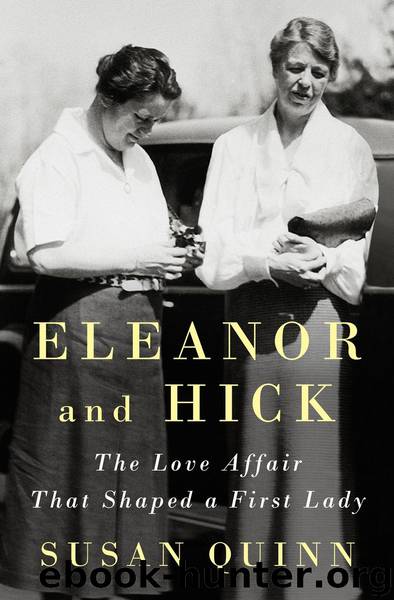
Author:Susan Quinn
Language: eng
Format: epub
Publisher: Penguin Publishing Group
Published: 2016-09-06T12:08:56+00:00
CHAPTER SEVENTEEN
A BETTER POLITICIAN THAN HER HUSBAND
TO L A HICKOK, STEVENS HOTEL CHICAGO
WILL ARRIVE ABOUT 6:40 CHICAGO DAYLIGHT SPECIAL PLANE, WILL NOT NEED A ROOM AS RETURNING AS SOON AS POSSIBLE
LOVE ELEANOR
ELEANOR’S TELEGRAM TO HICK said it all. Disagreement about FDR’s vice presidential choice at the Democratic convention in Chicago was threatening to derail his nomination for a third term. Eleanor had reluctantly agreed to fly to Chicago and give a speech, in hope of smoothing ruffled feathers. But she was determined to do it with as little disruption of her life as possible. She would fly in, do her duty, and fly out again on the same day. No need to stay over at the Stevens Hotel, which would be swarming with reporters and Democratic operatives. She had always disliked all the hoopla of political conventions, much preferring to follow events from Val-Kill with Tommy and Joe Lash.
Hick, of course, was the opposite. She savored every minute of the Democratic convention of 1940, where she was privy to the plots and counterplots, resentments and surprises. One surprise, right from the start, was that Democratic Party chairman Jim Farley, who had so successfully operated FDR’s previous campaigns, was only nominally in charge. “I’m the only one around here who doesn’t know anything,” Farley peevishly told a New York Times reporter on the first day of the convention. Did he have his usual direct line to FDR at the White House? Farley was asked. “Apparently,” he replied, “there is a different situation now.”
It didn’t take reporters long to discover that if there was a “smoke-filled room” in Chicago, it was located on the third floor of the Blackstone Hotel, in Harry Hopkins’s suite. Hopkins had a direct line to the White House in the bathroom, where he could discuss tactics with FDR in private. One convention delegate, using a rustic metaphor, explained that “the boys knew they had rings in their noses, but they did not know who held the leading strings.”
Hick knew, of course. Although she was fond of the man she called “the boss,” she understood how party regulars—including her current boss, Charlie Michelson, as well as Jim Farley—would resent the intrusion of Harry Hopkins, a social worker and political amateur, into the quadrennial party rite.
Nor was Hick surprised that the delegates were less than enthusiastic in the early going, given FDR’s refusal to state his own position on running for a third term. “I have thought for some time that he was overplaying his role of indifference and was displaying too much coyness,” Harold Ickes wrote in his diary. FDR didn’t want to ask for a third term, he wanted to be asked, unanimously if possible.
The mood of the convention intensified on the second day, when veteran orator Alben Barkley took the podium, starting off with a few jabs at Wendell Willkie, then moving on to shout the magic name of Roosevelt. For the next twenty-five minutes, the thirty-five hundred delegates turned into a “wild, shifting mass of screaming, standard-waving humanity.
Download
This site does not store any files on its server. We only index and link to content provided by other sites. Please contact the content providers to delete copyright contents if any and email us, we'll remove relevant links or contents immediately.
Fanny Burney by Claire Harman(26591)
Empire of the Sikhs by Patwant Singh(23066)
Out of India by Michael Foss(16841)
Leonardo da Vinci by Walter Isaacson(13304)
Small Great Things by Jodi Picoult(7112)
The Six Wives Of Henry VIII (WOMEN IN HISTORY) by Fraser Antonia(5493)
The Wind in My Hair by Masih Alinejad(5085)
A Higher Loyalty: Truth, Lies, and Leadership by James Comey(4945)
The Crown by Robert Lacey(4801)
The Lonely City by Olivia Laing(4796)
Millionaire: The Philanderer, Gambler, and Duelist Who Invented Modern Finance by Janet Gleeson(4457)
The Iron Duke by The Iron Duke(4345)
Papillon (English) by Henri Charrière(4251)
Sticky Fingers by Joe Hagan(4184)
Joan of Arc by Mary Gordon(4091)
Alive: The Story of the Andes Survivors by Piers Paul Read(4017)
Stalin by Stephen Kotkin(3953)
Aleister Crowley: The Biography by Tobias Churton(3628)
Ants Among Elephants by Sujatha Gidla(3458)
